

When temperatures rise, the railway doesn’t just get uncomfortable for staff, it becomes structurally vulnerable. Steel expands, joints close up, and restraint can be lost. If these risks aren’t managed, the result can be track misalignment, buckles, Emergency Speed Restrictions (ESRs), or worse.
Hot weather preparation is about anticipation, not reaction. Every activity below is designed to keep the track stable, predictable, and safe as rail temperatures climb well above air temperature.
I can tell you now that Hot Weather prep will be on the mind of every Track Section Manager right now up until April/ May. But below i will break down everything that runs in our minds prior to Summer.
Joint Gap Surveys:
Every Track Section Manager has jointed track in their Delivery Unit, Jointed track is extremely simple. Its a length of rail, often 60ft in length and is plated and bolted at either end to secure it. Each joint will have a gap between the two rails it is joining. This gap allows the rail to expand allowing the rail to be free to move. These gaps are determined by the Rail Temperature, and are set below:
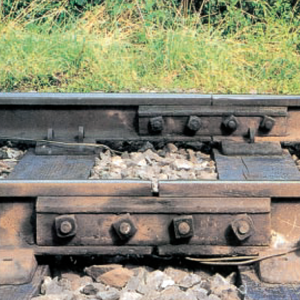

A joint gap survey measures the gap between rail ends at mechanical joints (including IBJs). These gaps are essential, they allow rails to expand safely as temperatures increase.
Why it matters in hot weather
Steel expands roughly 1 mm per 10 m per 10°C. Over long rail lengths, that expansion adds up quickly.
If gaps are:
-
Too small → rails have nowhere to expand → compressive forces build → buckle risk
-
Closed → stress transfers into sleepers and ballast → loss of lateral resistance
Joint gaps are one of the earliest warning indicators that the track is approaching a critical stress state.
What do we look for in a survey?
-
Consistent gaps for the season
-
No fully closed joints at moderate temperatures
-
Any signs of “creep” or uneven closure across a route
Joint gap surveys allow engineers to predict problems before rail temperatures peak.
Rail in Expansion with adequate joint gaps to expand into.

Rail in Expansion with inadequate gaps to expand into - Rail goes into compression.

What Happens after a joint gap survey?
Where surveys show insufficient gap, we mechanically adjust the rail, pulling or pushing it to reinstate the correct expansion allowance.
Why it matters in hot weather
A joint with no gap behaves like CWR (Continuous Welded Rail) it stores compressive stress but lacks the designed restraint and stress control.
When the rail has no room to expand, it goes into Compression, Rail is fastened down, and cannot move vertically, meaning the only way to go is laterally..
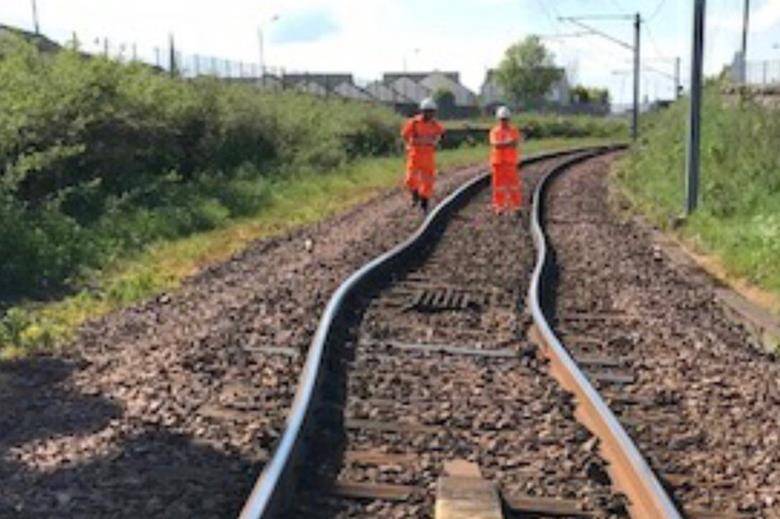
Key principle
This work is done before high temperatures arrive. Adjusting joints during a heatwave is risky, inefficient, and disruptive.
Looking after your joints
Prior to warmer weather, Rail engineers will lubricate every fish plated joint on their patch. Currently as part of weather prep each Delivery unit will be tasking their patrollers with lubricating each joint in their critical junctions and jointed areas. When we lubricate jointed track we ensure an even covering of grease between the rail and the plate. Why do we do this? Rail must be able to expand - longitudinally in a controlled state. If plates are dry or corroded then expansion becomes uneven, plates may cause the rail to "lock" and cause the rail to go into compression. It can then suddenly release causing a buckle.
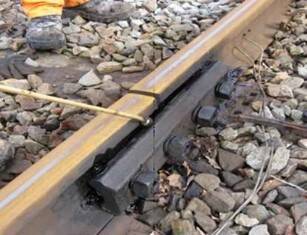


Adjustment Switches
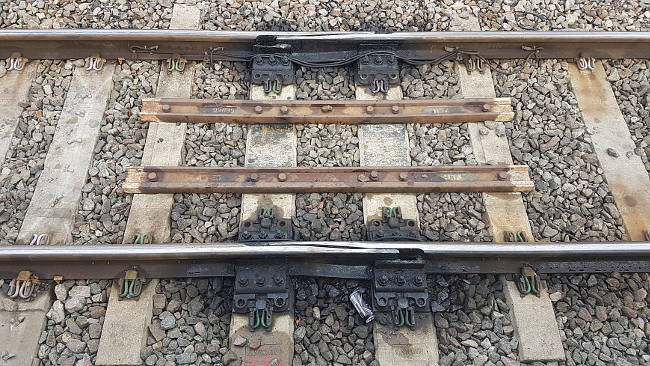
Adjustment Switches are found in track in areas between stressed track and areas such as unstrengthed switches and crossings, longitudinal timber layouts on bridges or between jointed track and stressed track.
Adjustment switches allow the expansion of rail between these entities and are a hotspot just like jointed track for buckles. Each winter/ summer these switches need to be adjusted prior to the onset of cold weather or warm weather. These are often adjusted by the movement of sleepers to provide adequate support, and the installation of rails off the back of the switches to allow adjustment. If the Adjustment switch isnt adjusted it can cause a buckle by going into compression or it can be a serious derailment risk if not supported adequately by its sleepers. Adjustment switches are also lubricated prior to the onset of warm weather, allowing smooth movement and controlled expansion. It is also important to ensure the bolts are tight on the plates to keep the switch rails restrained.


Ballast
Ballast is the absolute foundation of the railway. It might look simple, but without good ballast, you do not have good track.
Ballast is made from granite stone, chosen specifically for its angular shape and controlled size. That angularity is critical. When ballast is placed under load, the stones interlock, creating a stable but flexible foundation. This interlock is what allows the track to remain firmly held in position, while still being adjustable when maintenance or renewals are required.
As shown in the image above, ballast provides far more than just support. It:
-
Forms the structural foundation of the track
-
Allows free drainage, preventing water being trapped beneath sleepers
-
Contributes directly to ride quality
Although it appears basic, ballast condition underpins almost every aspect of track performance.
Ballast condition and risk
When ballast is in poor condition—such as wet beds, fouling, or track voiding (a lack of effective support beneath sleepers)—the risks increase significantly.
Poor ballast condition can lead to:
-
Reduced track stability
-
Loss of geometry
-
Increased dynamic loading from trains
-
Higher risk during hot weather
In hot conditions, these risks are amplified. Without effective ballast restraint, thermal forces in the rail are more likely to push the track out of line. A lack of ballast also limits our ability to carry out safe and effective repairs when they’re needed most.

Critical Rail Temperature (CRT)
Critical Rail Temperature, or CRT, is one of the most important concepts in hot weather railway engineering and one of the most misunderstood.
In simple terms, CRT is the rail temperature at which the track becomes unstable. Beyond this point, the compressive forces locked into the rail are greater than the track’s ability to restrain them. When that happens, the track can no longer hold its line, and the risk of buckling increases rapidly.
CRT isn’t a fixed number. It varies depending on the condition of the track, the ballast, the curvature, and how well the rail is restrained.
Steel expands when it gets hot. On the railway, that expansion is mostly locked in because the rail is restrained by sleepers, fastenings, ballast, and the formation beneath.
As rail temperature rises:
-
The rail wants to get longer
-
Restraint prevents that movement
-
Compressive forces build up internally
As long as the track restraint is stronger than the compressive force, the track stays stable. CRT is reached when those two things balance. Go beyond it, and the rail will try to release that energy sideways, this is how buckles occur.
These two terms below are closely linked but not the same.
Stress-Free Temperature (SFT)
This is the temperature at which the rail has no internal stress—it is neither in tension nor compression. This is what we aim to set during rail stressing.
Critical Rail Temperature (CRT)
This is the temperature at which the track structure can no longer safely restrain the rail.
Think of it like this:
-
SFT is about the rail
-
CRT is about the track as a system
A well-maintained track with strong ballast and good geometry will have a higher CRT than a poorly supported one—even if the SFT is the same.
How we calculate CRT
CRT is calculated by assessing how much lateral resistance the track has and how much compressive force the rail will generate as temperatures rise.
Key factors include:
1. Rail stress state
-
Stress-Free Temperature
-
Current rail temperature
-
Rail section and condition
The greater the difference between current rail temperature and SFT, the greater the compressive force.
2. Track curvature
Curves are inherently less stable than straight track. The tighter the radius:
-
The lower the CRT
-
The higher the buckle risk
This is why curves are often first to receive Emergency Speed Restrictions during heat.
3. Ballast condition (critical factor)
Ballast condition is one of the biggest contributors to CRT.
Good ballast:
-
Increases lateral resistance
-
Anchors sleepers
-
Raises CRT
Poor ballast, such as wet beds, fouling, voiding, or inadequate shoulders, dramatically lowers CRT.
Ballast shoulders alone contribute around 40% of track lateral stability, which is why shoulder dimensions and condition are explicitly considered in CRT assessments.
4. Sleeper type and spacing
-
Concrete sleepers generally provide greater restraint than timber
-
Sleeper condition and spacing influence how forces are distributed
5. Track geometry and defects
Poor geometry, twist, or cyclic top faults reduce the track’s ability to resist thermal forces, lowering CRT.
So what do we do to manage CRT and protect traffic:
CRT is not something we “manage” on the day it’s something we influence months in advance through good planning and maintenance.
1. Improve ballast condition
-
Tamping and regulating
-
Restoring ballast shoulders
-
Treating wet beds and voiding
This raises lateral resistance and increases CRT.
2. Correct rail stressing
-
Ensuring rails are stressed to the correct SFT
-
Re-stressing where history or condition is uncertain
Correct stressing reduces excessive compressive forces in summer.
3. Maintain joints and expansion capacity
- Joint gap surveys
-
Adjustments where gaps are tight or closed
This prevents compressive stress concentrating in localised areas.
4. Lubrication of plates and S&C
-
Allows controlled rail movement
-
Prevents stress locking up locally
5. Enhanced inspections and monitoring
-
Remote Temperature Monitoring, Once Thresholds are triggered a site watchman is deployed.
-
Monitoring historical buckle locations
-
Watching curves, S&C, and poor ballast areas closely
6. Speed restrictions where required
When engineering controls cannot raise CRT sufficiently, ESRs are used as a last line of defence.
Reducing speed:
-
Lowers dynamic forces
-
Reduces the likelihood of triggering a buckle
-
Buys time until permanent fixes can be delivered


The Final Piece of the Puzzle.. Rail Stressing:
Continuous Welded Rail (CWR) has many benefits for Engineers, It allows smoother rides, less maintenance of the track and allows higher line speeds. But during hot weather periods CWR still requires expansion, just like a jointed rail would, but there is no gap to allow expansion. How do we allow expansion in hot weather for a rail that is fastened down and welded at both ends.
We Stress rail, As mentioned above rail has a Stress Free Temperature (SFT), In the UK this is 27C. The SFT is the point at which there are no compressive or tensile forces acting upon the rail.
As shown above in the diagram for Jointed Rail:
- Below 27C: The rail is effectively in a tensile state with forces causing the rail to contract.
- Above 27C: The rail goes into compressive state with forces causing the rail to expand.

Now to throw a spanner into the works some rails are often welded into track below SFT and at air temperature. This creates a rail with a low SFT. This then creates a "weak spot" within the track. This low SFT section of rail has nowhere to expand to apart from laterally. This is where CRT calculations come into play. At lower air temperatures this section of installed rail will go into a compressive state.
We stress rails to overcome this. To ensure a rail is stressed to its optimum SFT (27C), the rail is cut and the rail is unfastened for a set measurement. often a minimum of 180 meters (90 meters each side of the site that needs stressing) This can be higher dependant on the length of the site with a low SFT.
The rail will often contract once cut, and automatically set itself to the air temperature. This is critical as it gives us the current Stress Free Temperature of the site. This can be worked out with the below equation:

SFT = Stress Free Temperature (°C)
𝑇𝑟 = Rail temperature when measured (°C)
ΔL = Change in rail length (m)
Positive = rail pulled longer
Negative = rail shortened
α = Thermal expansion coefficient of steel
≈ 0.0000115 /°C
L = Length of rail being stressed (m)
To calculate the extension needed to ensure the rail reaches 27C SFT when stressed we use the equation below:
e=1000 LXt
e = extension in milimeters
L = length of free rail in meters
X = Coefficient of expansion of steel (0.0000115 per C for normal grade rail).
t = Temperature difference between SFT and rail temperature. Example below:
Free rail length = 200m - Rail Temp = 10C.
e= 1000 x 200 x 0.0000115 x 27-10 = 39.1mm extension required.
To ensure we reach the correct pull force in case we are stressing on tight curves etc. we use the below:
Rail steel constant x rail weight per foot (lb) x SFT - rail temp. or 0.01543 x L x ΔT
0.01543 x 113 x 27-10 = 29.64 tonnes
x110 = 3260psi
We undertake the psi conversion above to ensure we are putting the correct force into the rail to prevent overstressing.
Ensuring the rail is sat with no compressive or tensile forces ensures that there is minimal buckle risk in hot weather and reduces the risk of a fracture during cold weather.
Making Key Decisions in the Height of Summer
Hot weather changes the rules for track maintenance...
When rail temperatures rise, the forces locked into Continuous Welded Rail (CWR) increase. The track becomes more sensitive to any loss of restraint, and that’s where summer decision-making gets serious. Rail Engineers still need to deliver repairs on a live railway, but every intervention has to be weighed against one question:
Will this work reduce track stability and bring the site closer to its Critical Rail Temperature (CRT)?
Because if it does, we may still proceed, but only with the right controls, monitoring, and sometimes speed restrictions to protect traffic.
This article explains how we make those decisions, from rail defects to lifting and packing, and tamping, using CRT as the key driver.
Why summer is different: CRT and track stability
CRT is the rail temperature at which the track is considered at greater risk of buckling, based on how well it is restrained and how much thermal force is being carried.
In practical terms, the summer period is about managing risk:
-
Higher rail temperatures mean higher compressive forces in the rail.
-
Any reduction in lateral resistance (track restraint) increases buckle likelihood.
-
Some repairs temporarily reduce stability before the track “locks back up”.
So the decision isn’t simply “can we fix it?”
It’s: can we fix it without creating a bigger risk in the afternoon heat?
The two big summer repair types (and why they matter)
1) Track geometry work: lifting & packing / tamping
Geometry work often involves disturbing the ballast bed. Even when the track looks perfect after the work, the ballast has not fully re-consolidated.
That matters because ballast is the track’s primary restraint system, it is what resists lateral movement and helps prevent a buckle. When it’s disturbed, the track can be more vulnerable until traffic has helped it settle and “lock” again.
What we consider before doing geometry work in summer:
-
Current and forecast rail temperatures
-
Site history (previous buckles, weak formation, wet beds, voiding)
-
Amount of disturbance required (light packing vs full tamp)
-
Condition of shoulders and crib ballast (is the track properly boxed in?)
-
Whether we can apply controls immediately after handback
Typical control measure: settlement period + speed restriction
Where stability is temporarily reduced, we’ll often impose a temporary speed restriction to reduce dynamic forces and lateral loading while the ballast re-consolidates under traffic. This buys us time for the track to regain strength without exposing it to unnecessary risk during peak temperatures.
2) Rail defects and rail changes (especially without stress restoration)
Rail defects don’t wait for convenient seasons.
Sometimes we must remove a defect under extreme time pressure. In an ideal world, rail changes are followed by full stress restoration to ensure the rail returns to the correct Stress-Free Temperature (SFT). But in real operations, access time, possession limits, and operational need can mean that’s not always achievable immediately.
In these situations, replacement rail may be installed at a lower SFT than ideal, which can reduce the safe operating margin in hot weather effectively shifting the risk profile and influencing CRT considerations.
What we consider before replacing rail under time pressure:
-
Severity and type of defect (immediate safety risk vs monitorable)
-
Whether we can complete stress restore in the same access window
-
Forecast rail temperatures post-hand back
-
The consequences of delay vs the consequences of temporary restrictions
-
Whether enhanced monitoring can safely bridge the gap to a later stress restore
When we proceed but manage it: hot-weather restrictions
If the site’s risk profile is increased after the repair, it may be necessary to implement hot-weather speed restrictions during the warmest part of the day. That’s not a decision anyone enjoys, but sometimes it’s the safest option to keep trains running while protecting against buckles.
The “summer dance”: balancing handback, safety, and performance
The reality of modern railways is infrastructure is aging and traffic levels are high..
We find ourselves in a world where possession time is limited and expectations on reliability are constant
That creates a balancing act, sometimes a genuine “dance” between:
-
Handing back safely and on time
-
Maintaining stability in high rail temperatures
-
Avoiding Emergency Speed Restrictions
-
Preventing disruption to start-of-day services
Rail Engineers often have visibility of developing issues well before they become emergencies. That’s where judgement comes in: deciding whether to:
Option A: Proceed now with controls
If safety demands immediate intervention, we may complete the work and apply controls such as temporary speed restrictions (settlement or hot-weather based) with enhanced inspection/monitoring or local mitigations to improve restraint (where feasible)
Option B: Monitor and defer to a better window
If the defect is safely manageable, we may increase monitoring frequency or manage risk through operational controls.
But more than often its better to plan the repair for cooler conditions and schedule stress restoration at the earliest viable opportunity
Neither option is “easy”. Both require engineering judgement, strong local knowledge, and clear communication across maintenance and operations.
What “good” looks like in summer decision-making
Across rail defects, geometry works, and tamping, strong summer decision-making tends to be:
-
data-led (CRT/SFT awareness, temp forecasts, asset history)
-
risk-based (what’s the consequence and likelihood if we do / don’t?)
-
operationally realistic (possession limits, traffic levels, access constraints)
-
control-focused (monitoring, restrictions, and follow-up stress restore planning)
Because the goal isn’t just to “fix the fault”. The goal is to fix it without creating risks.
Closing thought
Every summer, Rail Engineers are tasked with keeping the railway safe through a period where the track is at its most sensitive, while still delivering repairs, maintaining performance, and avoiding disruption.
It’s a constant assessment of risk, restraint, CRT, and practicality, and it’s one of the most challenging parts of maintaining a live railway.

Add comment
Comments
Jamie, a great read and summary of issues. Like Chris i feel there needs to be a reference to 'disturbance risk' during high temperatures. Also perhaps describe how Adjustment switches should be dimensionally set when installed and how they should be continuously monitored and measured. Rail creep, especially on gradients and areas of high traction and braking. Great work - keep it up!
Thanks Phil, I will make some adjustments. Always open to feedback. As mentioned to Chris, I was racking my brains on how far to go with Adjustment switches and disturbance. I planned on doing an article on reacting to work in the summer at some point.
Excellent work Jamie. I've had a quick read through & liked what I saw.
However, I do think you need to make the point that track should not be disturbed in periods when high temperatures are likely. I've no doubt that you're well aware of this, but to me it didn't come across here.
For example, you mention that tamping & other maintenance work can increase track stability. That is true as long as disturbed track has the chance to reconsolidate afterwards, before high rail temperatures arise. The passage of sufficient traffic can ensure this, and the use of a DTS can speed it up. Track engineers need to be well aware that one common cause of buckles has been well intentioned track maintenance done too late. Buckles have resulted when track has got hot before it has reconsolidated after work.
Thanks Chris. I appreciate the feedback. As mentioned i was racking my brains on how far to delve into Adjustment Switches. I did cover abit on disturbance but will elaborate abit further. Keep commenting if you want to see something. I appreciate it.
What a great article, thank you
Thanks Ian :)